Why Your Event Tech Is Tracking Activity, Not Outcome
Why Your Event Tech Is Tracking Activity, Not Outcome
Let's talk about the dashboard you pull up after every event.
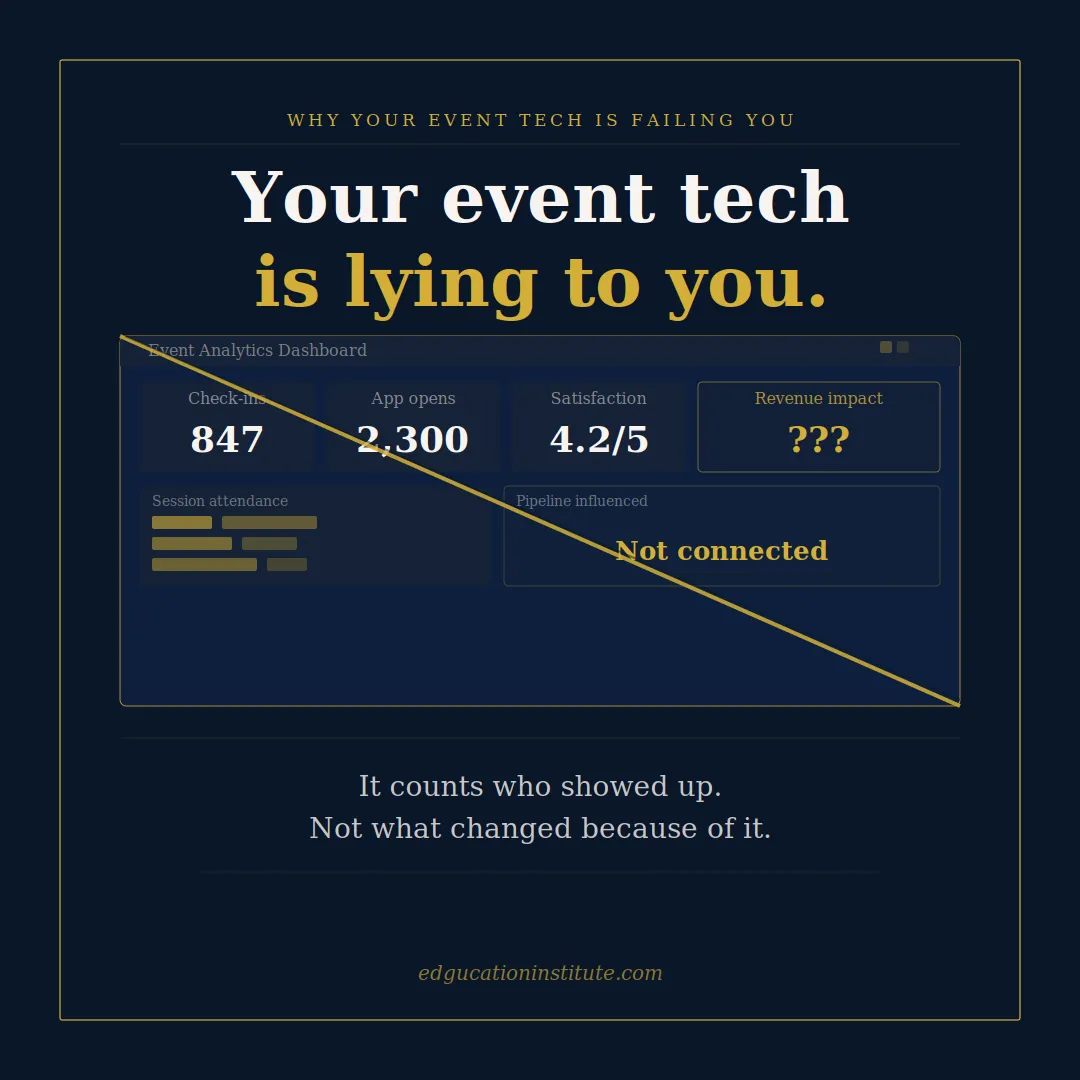
Check-ins: 847. Session attendance: strong. App opens: 2,300. Attendee satisfaction: 4.2 out of 5. The client loves it. Your team is exhausted but proud. You send the recap report and call it a success.
Now answer this: how many of those 847 people made a purchase, signed a contract, renewed a relationship, or changed their mind about something because of what happened in that room?
If you cannot answer that question, you are not measuring your event. You are measuring your event's activity. And there is a difference that is quietly costing you your seat at the table.
The platform was never built to answer the question that matters
This is not your failure. It is an architecture problem baked into the tools most planners are handed.
The dominant event platforms — the ones managing your registration, your check-in, your mobile app, your post-event survey — were originally built to solve an operational problem. They are exceptionally good at telling you who showed up, which sessions they attended, how long they stayed, and whether they gave you four stars or five. That data is useful. It is also almost entirely about activity.
A recent analysis of event analytics platforms put it plainly: "The gap most teams face is that activity metrics are easy to capture; connecting them to business outcomes requires intentional system design." That intentional system design is something most planners have never been asked to build. And the platforms have not built it for them.
Forrester's 2024 B2B Events Survey found that only 1 in 5 enterprise organizations have integrated their event platform with their marketing technology. One in five. That means 80 percent of organizations are running events where the data never makes it into a CRM, never gets connected to a pipeline report, and never tells the sales team what actually happened. The event data lives in a silo. And when data lives in a silo, it cannot prove anything.
What activity metrics actually tell you
Check-in rate tells you who walked through the door. It does not tell you whether the door led anywhere meaningful.
Session attendance tells you which room people sat in. It does not tell you whether they left that room with a changed belief, a new intention, or a decision they would act on by Friday.
App opens and engagement scores tell you whether people interacted with your content. They do not tell you whether that interaction moved them closer to the behavior your client needed them to take.
Net Promoter Score tells you whether attendees would recommend the event. It does not tell you whether the event influenced a sale, retained a customer, or accelerated a deal.
These metrics are not worthless. But they answer a question no executive is actually asking. According to Bizzabo's 2026 State of Events research, what leadership actually wants to understand is "what changed in the business as a result of the event." Attendance numbers and satisfaction scores do not answer that question. They cannot.
The stat that should stop you cold
According to Demand Gen Report's 2025 survey, only 21 percent of B2B marketers can measure event ROI with confidence.
The remaining 79 percent are making budget decisions about their largest marketing channel based on attendance data and intuition.
Read that again. Nearly 8 in 10 event professionals are going into budget conversations armed with check-in counts and session ratings while being asked to justify investments that often run into six figures. They are losing those conversations. Not because they did not execute well. Because they cannot prove what the event actually did.
Why the tools keep selling you activity metrics
Event technology is a booming market. The global event management software market was valued at over $11.5 billion in 2025 and is projected to exceed $36 billion by 2035. Vendors are competing aggressively on features, and the features that are easiest to demo — the ones that look impressive in a sales deck — are engagement features.
Smart badges that track foot traffic. AI-powered session recommendations. Real-time app engagement dashboards. Heat maps of attendee movement through the expo hall. These are visually compelling. They are genuinely useful for operational decisions. And they are still activity metrics.
The technology to connect events to business outcomes exists. CRM integration, pipeline attribution modeling, post-event conversion tracking — these capabilities are available. But they require intentional architecture. They require the event professional to know what outcome they are designing for before the planning begins, and to build the measurement infrastructure backward from that outcome.
Most planners are not doing this. Not because they are incapable, but because no one has ever taught them that it is their job.
The question that changes everything
Every event your client is paying for exists to produce a behavior. A purchase. A renewal. A referral. A shift in perception that makes a future sale more likely. An acceleration of a deal that was stalling.
If you do not define that behavior before you begin designing the event, you have no way to measure whether it happened. And if you cannot measure whether it happened, you will always be defending your value with activity metrics to people who are asking outcome questions.
The discipline Karlene Palmer, Senior Experiential Manager at Proximo Spirits, describes in her team's approach is the right one: "The discipline is designing the measurement before the activation, not after. Ask: what KPI does this tie to? What decision would this data inform? If you can answer that, the metric earns its seat at the table."
That is not a technology problem. That is a strategic design problem. And it is one that the most sophisticated event professionals — the ones whose budgets are growing while everyone else is defending theirs — have already solved.
What outcome measurement actually looks like
It starts before the event brief. It starts with the question your client has not been asked yet: What behavior do we need this event to produce, and how will we know if it happened?
From there, measurement is designed backward. If the outcome is pipeline acceleration, you connect your attendee data to your CRM and track deal velocity before and after the event. If the outcome is customer retention, you measure renewal rates among the attendees versus a comparable non-attendee cohort. If the outcome is a purchase decision, you track conversion rates in the 30, 60, and 90 days following the event and compare them to your baseline.
This is not complicated. It requires a different way of thinking about what an event is. An event is not a moment to be executed. It is a strategic intervention designed to move people from one state of mind or one stage of a decision to the next. When you design it that way, measurement becomes obvious. When you design it as a logistics exercise, measurement stays forever elusive.
The uncomfortable truth about your dashboard
Your event tech is tracking what it was built to track. That is not the problem. The problem is mistaking that data for proof of value.
The planners who are securing larger budgets, earning seats at strategy tables, and being treated as partners rather than vendors are not the ones with the most impressive engagement dashboards. They are the ones who can walk into a post-event debrief and say: here is the business outcome we designed for, here is how we measured it, and here is what the data shows.
That capability does not come from a better platform. It comes from a different way of thinking about what your job actually is.
Ready to find out where you stand?
If this landed differently than you expected, that is worth paying attention to.
The gap between activity thinking and outcome thinking is exactly what the CPES certification was built to close. It is not a credential about planning better events. It is a credential about thinking differently about what events are for.
→ Take the quiz to find out how strategic your event thinking really is.