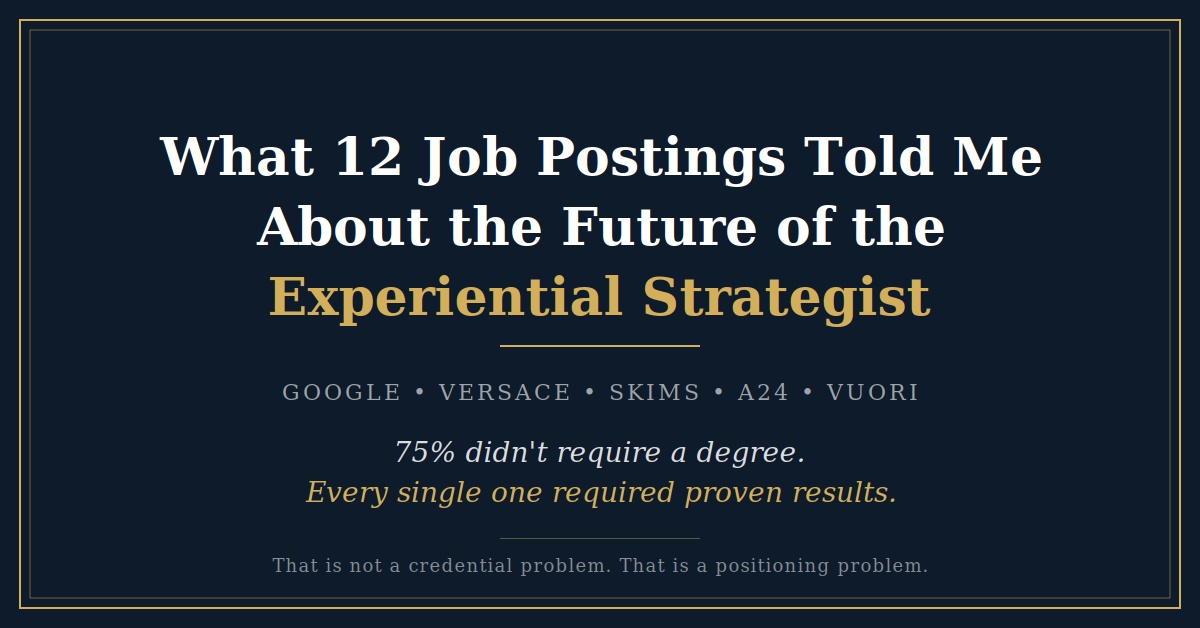
What 12 Job Postings Told Me About the Future of the Experiential Strategist
I spent some tine last week researching industry job openings. I see alot of planners looking for work these days. I pulled 12 real experiential marketing job postings from brands that are setting the standard right now. Google. Reddit. Versace. Vuori. SKIMS. A24. Brands that represent culture, commerce, and consumer behavior at the highest level.
I was looking for one thing: what does the market actually require from the people it hires to design and execute experiences?
What I found was not what most event planners expect to hear.
75% of those postings did not require a degree.
Not one of them specified a marketing degree. Not one of them asked for a hospitality credential. Not one of them cared about the certification on your wall.
But every single one required the same thing.
Proven results.
A track record of campaigns and events that actually moved something. Revenue. Awareness. Behavior. One posting after another used language like "demonstrated ability to deliver measurable impact," "proven track record of experiential activations that deliver customer value and brand impact," and "strong track record of creating innovative, differentiated experiences." The SKIMS posting asked for proven experience leading strategy and execution of physical activations. The Walmart experiential role called for someone who "blends creativity with strategic thinking." JP Morgan Chase asked for a "proven track record developing and executing experiential marketing strategies within a large enterprise."
None of them asked how long you have been planning events. All of them asked what your events actually produced.
This is not a credential problem. It is a positioning problem.
Here is what makes this finding so significant. The event planning profession is young. Meeting Professionals International was not founded until 1972. The Certified Meeting Professional designation did not exist until 1985. Formal education programs in event management are even more recent than that. Which means the vast majority of working event professionals in this industry learned by doing. They came from HR departments, administrative roles, hospitality, office management. They figured it out on the job and got extraordinarily good at it.
But not one person in that process sat them down and said: here is how you design an event to create a specific, measurable outcome. Here is the framework. Here is how you prove what you built.
And so an entire generation of talented, experienced event professionals is sitting on years of high level execution with no language to describe what it produced. No framework to connect the experience they designed to the behavior it drove to the business result it generated.
The brands hiring right now do not want a planner. They want a strategist who can prove their work moved something.
What the Experiential Strategist role actually requires
When you look at what these job postings are describing, they are not asking for someone who can execute a run of show. They are asking for someone who can:
Design an experience with a clear intended outcome before the first vendor call is made. Connect creative decisions to behavioral goals. Measure and report results in the language of business. Speak to stakeholders about impact, not just logistics.
That is a specific skill set. And it is learnable. It is not a function of how many events you have planned. It is a function of how you were taught to think about the planning itself.
Most event professionals were taught to plan from the checklist forward. Venue. Catering. AV. Registration. Run of show. The list drives the process and the outcome is whatever happens when the list is complete.
The Experiential Strategist plans from the outcome backward. What do we need people to do after this event? What do they need to feel in order to do that? What experience produces that feeling? Now build the checklist.
Same profession. Entirely different methodology. And an entirely different value proposition in the market.
The gap is closable
The good news is this. If you have been executing events at a high level for years, you already have the raw material. You have the instincts, the relationships, the operational expertise. What most planners are missing is not experience. It is the framework to translate that experience into the language the market is now demanding.
When you can walk into a client meeting and say: here is the behavior I am designing for, here is the emotional mechanism I am using to produce it, and here is how we will measure whether it worked, you are no longer a planner. You are a strategist. And the market is paying for that distinction.
The Experiential Edge Blueprint, taught inside the Certified Professional Experiential Strategist certification, is that framework. It gives you a repeatable methodology for designing events with measurable outcome every single time, and the language to prove your value before, during, and after every event you produce.
If the brands you want to work with are already asking for proven results, the question is not whether you need a framework. The question is how long you can afford to go without one.
Learn more about the CPES at edgucationinstitute.com.