The Difference Between an Event Planner and an Experiential Strategist
I was an event planner for a really long time.
And if I am being honest, what I did not like about it was being treated as a logistics coordinator executing someone else's vision. I was good at it. Really good at it. But I was invisible in it. The event would go beautifully and the credit went to the venue, the caterer, the florals. My job was to make sure nothing went wrong. Not to shape what went right.
So I went out on my own.
I thought independence would give me creative freedom. And it did. But it also gave me something I was not prepared for. Vulnerability.
When you work for someone else, success is defined for you. When you work for yourself, you have to define it. And when you cannot define it clearly, someone else will define it for you. And they will not be generous.
That lesson came in the form of burnt sweet potatoes, an out of line bartender, and long valet lines.
I had just executed what I considered one of the best events of my career to that point. The design was stunning. The flow was intentional. The guests were engaged. I left feeling proud.
My client called it a total failure.
Not because of the strategy. Not because of the design. Because of three operational hiccups that had nothing to do with what I had built and everything to do with what we had never agreed on before the event began.
We had never defined what success looked like. So when things went sideways on the edges, there was nothing to point to that proved the center had held.
That was the moment everything changed for me.
I realized I could not let someone else define success for me. And I could not let my career rise and fall on burnt sweet potatoes.
So I built the framework. Not just to protect my work. To protect yours too.
Here Is the Actual Difference
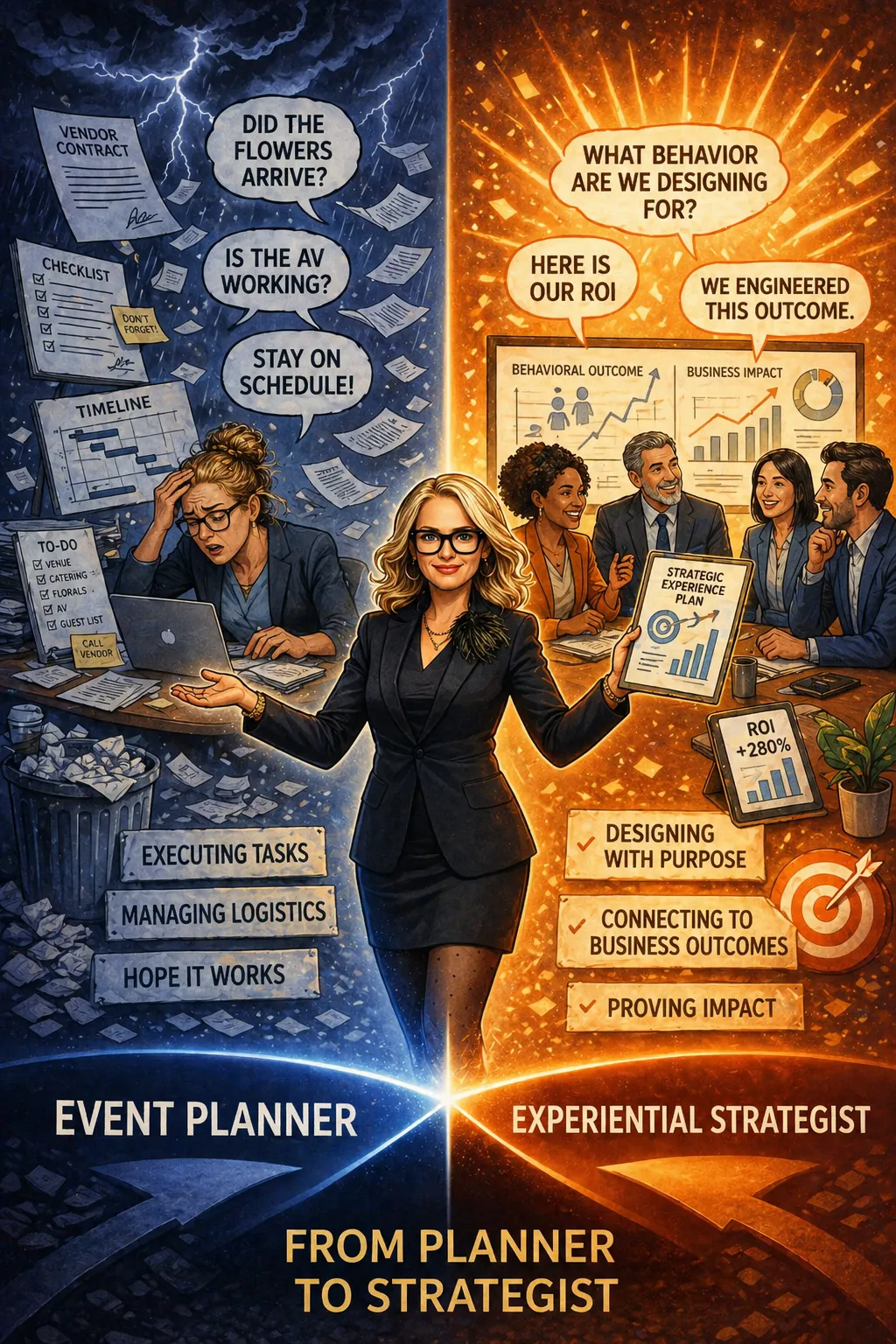
An event planner executes. An experiential strategist designs.
That is not a criticism of planners. Execution is a skill. It takes precision, resilience, and the ability to hold a thousand moving parts together under pressure. Those things are real and they are hard.
But execution without strategy is always vulnerable. Because if you never defined what the event was supposed to do before it began, anyone can walk in after the fact and tell you it failed. And you will have nothing to stand on.
Here is what the distinction actually looks like in practice.
An event planner asks what needs to happen. An experiential strategist asks what needs to change.
An event planner manages vendors. An experiential strategist manages outcomes.
An event planner delivers a beautiful room. An experiential strategist delivers a measurable result.
An event planner hopes the client is happy. An experiential strategist defined what happiness looked like before the first vendor was called.
An event planner produces a photo album. An experiential strategist produces an impact report.
The planning before the planning is where everything changes. Before a venue is selected, before an agenda is built, before a single vendor is booked, an experiential strategist asks the questions that make every decision that follows more intentional, more aligned, and more provable.
What business objective does this event support? What does success look like before the first guest arrives? What emotion do we need to create and what behavior do we need to drive? And how will we measure whether it worked?
When you answer those questions first, you are no longer executing someone else's vision. You are architecting your own. And when the sweet potatoes burn and the valet line backs up and the bartender says something he should not have said, you have something to stand on. Because success was defined before the event began. And the event delivered it.
That is what makes you indispensable.
That is what makes you a strategist.
How to Get There
The shift from planner to strategist is not about doing more. It is about thinking differently before you do anything at all.
It starts with asking better questions before the planning begins. What is this event designed to change? What behavior do we need from this audience? What emotion will drive that behavior? How will we know it worked?
It continues with learning to speak the language of business outcomes. Not describing what the event was. Describing what the event did. Not a two-day leadership retreat. An alignment experience that reduced internal resistance to the Q3 strategy rollout. Not a client dinner. A relationship investment that contributed to three contract renewals within thirty days.
And it is completed by building the measurement plan before the event, not scrambling to justify results after it.
The moment you can walk into a pre-event conversation with a strategic brief and walk out of a post-event conversation with an impact report, you are no longer a planner defending your work.
You are a strategist proving your value.
And nobody can take that away from you. Not even burnt sweet potatoes.