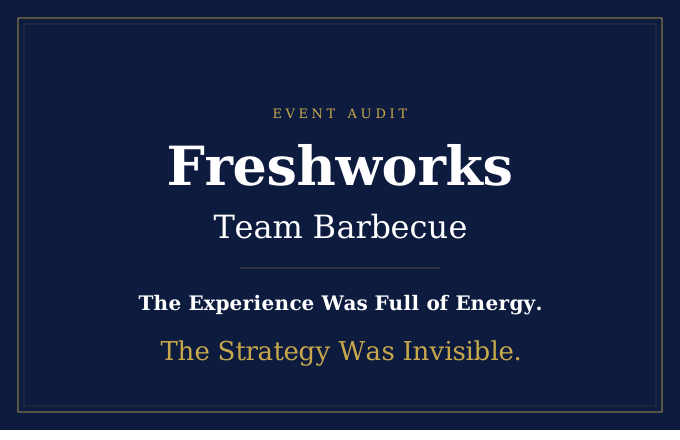
Event Audit: Freshworks Team Barbecue
How a High-Energy Team Event Created the Right Experience but Missed the Strategic Outcome
Recently, I looked back at a team building event I designed for Freshworks.
The goal was to bring together approximately 200 employees for a casual, high-energy barbecue experience focused on connection and team bonding.
The environment was intentionally relaxed.
There was a live barbecue on site, designed to trigger nostalgia through smell and familiarity. A dodgeball tournament became the centerpiece of the experience, with teams creating their own jerseys, some even making custom Hawaiian shirts featuring their boss’s name. A DJ dressed as a referee added humor and personality, interacting with players and keeping the energy high throughout the day.
From an experiential standpoint, the event worked.
People participated.
They laughed.
They engaged with each other in a way that felt natural and unforced.
If you were measuring success based on attendance and engagement, this event would have been considered a clear win.
But looking at it now through the lens of experiential strategy, something critical was missing.
Where We Got It Right
This event was designed with strong emotional instincts, even if they were not formally defined at the time.
The use of nostalgia through barbecue and outdoor elements created a sense of comfort and familiarity. That emotional foundation supports belonging, which is one of the most important drivers of team connection.
The dodgeball tournament introduced competition and participation, which increased engagement and interaction across teams. This moved the experience beyond passive attendance and into active involvement.
The personalization of jerseys and team identities added another layer of emotional investment. When people create something of their own within an experience, they become more connected to it.
From a planner’s perspective, the event did exactly what it was supposed to do.
It created energy.
It created connection.
It created memorable moments.
What Was Missing
The most important step in strategic event design never happened.
We never defined the behavioral outcome.
The intention was to bring teams together, but we did not clearly establish what that should look like in action.
Did we want to see increased cross-team collaboration?
Stronger internal relationships?
Improved communication between departments?
Without defining the desired behavior, we also had no way to measure it.
There were no pre-event surveys to establish a baseline.
There were no post-event measurements to assess change.
There were no metrics tied to business outcomes.
And without that, the event, while successful in experience, could not be proven as successful in impact.
This is where many events lose their value in the eyes of leadership.
How I Would Design It Today
Today, I would approach this event very differently.
Before any decisions were made about food, activities, or entertainment, I would define three things.
1. The Purpose of the Event
The purpose would be clearly tied to a business objective.
For example, improving cross-team collaboration or increasing internal alignment.
This moves the event from a “team building day” to a strategic initiative.
2. The Emotional Outcome
Emotion would be intentionally designed based on the desired behavior.
For a team event like this, the focus might be:
Belonging
Trust
Connection
Shared identity
These emotions would guide every design decision, from how teams are formed to how activities are structured.
3. Measurable Behavioral Outcomes
This is where the event becomes strategic.
If the goal is collaboration, we would measure:
Increase in cross-team communication
Post-event collaboration between departments
Employee perception of team connection
This could be done through pre and post-event surveys, internal metrics, or team-based feedback.
When behavior is defined and measured, the event can be directly connected to business impact.
The Lesson
This event reinforced something I now teach in every framework.
A great experience is not the same as a successful event.
The Freshworks barbecue created the right environment. It sparked connection and engagement.
But because the behavior was never clearly defined or measured, the outcome could not be proven.
And in today’s business environment, if you cannot prove the outcome, the value is questioned.
When you define the behavior first, you design differently.
When you design with intention, you measure differently.
And when you measure behavior, you can finally connect events to real business results.
That is the difference between planning an event and designing a strategic experience.
If this resonates with you, download my free guideWhy Great Events Still Fail to Prove ROI and start building events that drive measurable outcomes.