How to Get From Event Planner to Experiential Strategist: The 5 Things Nobody Taught Us
How to Get From Event Planner to Experiential Strategist: The 5 Things Nobody Taught Us
Let me start with a confession.
Nobody taught me how to do this job.
I did not walk into the events industry through a formal training program or a clearly defined career path. Like so many of us, I was thrown in. Not into a simple holiday party or a one-time corporate luncheon. My first real event was a three-day ticketed wine tour. Three days. Ticketed. With real guests who paid real money and expected a real experience.
I figured it out. But it was jenky. And I will be the first to admit that.
What I did not know then, and what nobody in this industry is formally taught, is that executing an event and designing a strategic experience are two completely different things. One gets you through the weekend. The other builds a career.
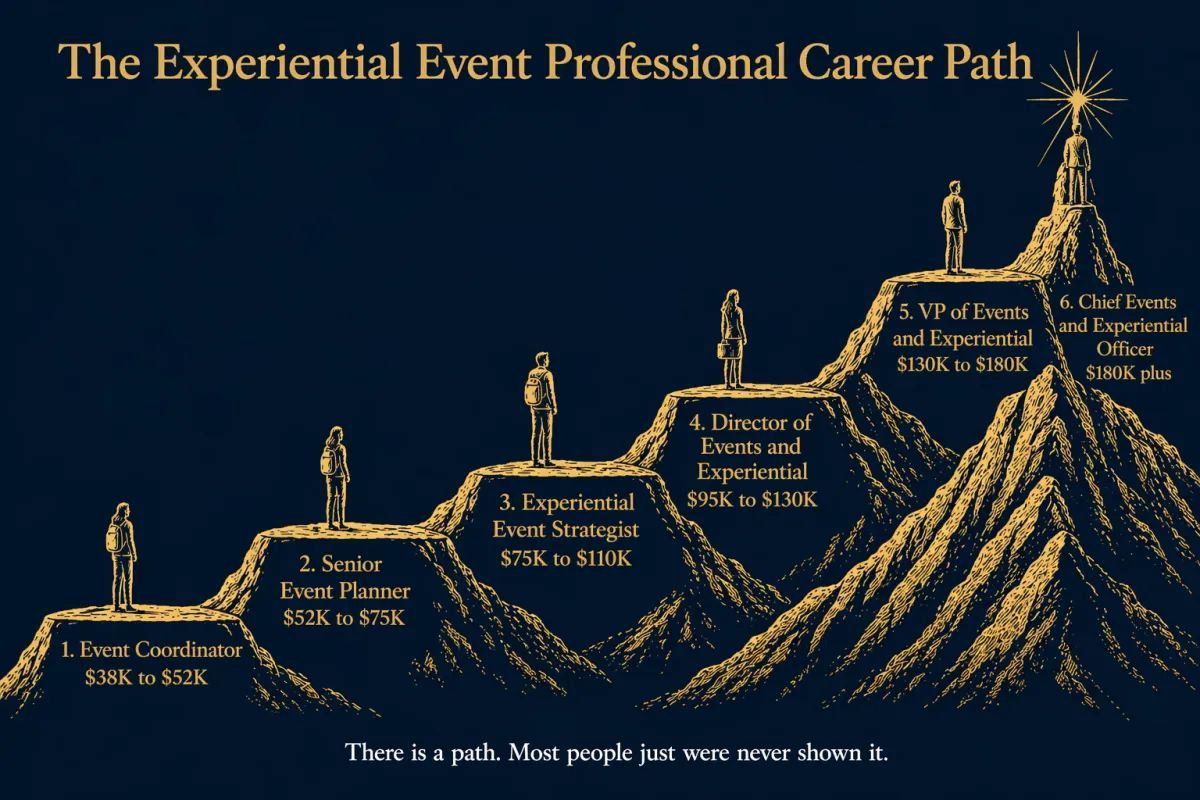
The career path graphic I shared this week shows the gap clearly. There is a step between Senior Event Planner and Director of Events and Experiential that the industry forgot to build. That step is called Experiential Event Strategist. And the reason most planners never make it there is not because they lack talent. It is because nobody ever showed them what that step actually requires.
So let me show you.
Here are the five things that take you from executing events to designing experiences that produce measurable business outcomes.
One. Start With Purpose Before You Open a Venue Search
Most event professionals open a venue search before they have answered a single strategic question. They build an agenda before they know what behavior they need to drive. They book vendors before they have defined what the event needs to accomplish.
This is not a criticism. It is simply how the industry has always worked. And it is exactly why so many well executed events fail to prove their value.
The planning before the planning is where everything changes. Before a venue is selected, before an agenda is built, before a single speaker is booked, a strategist asks one question: what does this event need to do for the business?
That question changes every decision that follows.
Two. Name the Emotion Before You Design the Experience
Here is what I learned the hard way on that three-day wine tour. People do not remember the agenda. They do not remember the schedule or the speaker lineup or the carefully curated vendor list. They remember how it made them feel.
Emotion is not decoration. It is the engine.
The science behind this is clear. People make decisions based on how they feel and they remember experiences based on the emotions those experiences created. Which means if you are not designing for a specific emotional state, you are leaving the most powerful tool in the room completely on the table.
Before you design a single moment, name the emotion you are designing for. Not a vague positive feeling. A specific one. Trust drives different behavior than excitement. Inspiration drives different behavior than urgency. Name it precisely and then build everything to create it.
Three. Connect Every Decision to a Behavior
Emotion without direction produces a nice experience. Emotion connected to a behavioral goal produces a strategic one.
This was the piece I had to learn after that first event. I could create an amazing experience. People would leave raving about it. And then my client would look at me and ask what it actually did for the business and I would have nothing to say.
The most powerful planning question in Strategic Experience Design is this: what has to be true after this event that is not true right now?
Not what do you want people to feel. Not what do you want people to say. What do you need them to do. Specifically. Observably. Measurably.
Schedule a follow up meeting. Renew their contract. Adopt the new process. Refer a colleague. These are behaviors. Feel inspired is not a behavior. It is a hope dressed up as a goal.
Name the behavior before you design a single moment and every decision you make from that point forward has a filter.
Four. Design the Peak and Perfect the End
Nobel Prize winning psychologist Daniel Kahneman found something that permanently changed how strategists approach events. People do not judge an experience by its average. They judge it by two moments only: the emotional peak and how it ended.
Most event planners spend the majority of their time designing the middle. The breakout sessions. The catering. The production value. The networking hour. Strategists protect the peak and perfect the end.
Your peak does not have to be the loudest moment in the room. It has to be the most emotionally charged. A quiet precisely placed moment can outlast a spectacular production number if it connects to what your audience actually cares about.
And your ending is the final emotional imprint. The last feeling an attendee carries with them as they walk out the door. Design it with as much intention as your opening. More, actually. Because the ending is what stays.
Five. Measure Outcomes Not Activity
This is where I stopped defending myself in every post-event conversation. And this is where your career changes permanently.
Most event reports measure one thing: what happened. Attendance numbers. Ticket sales. Post event survey scores. These are surface metrics. They tell you the event occurred. They do not tell you the event worked.
Experiential Strategists report across three dimensions. KPI outcomes which are the hard business metrics that leadership speaks fluently. Behavioral outcomes which measure whether attendees actually did what you designed them to do. And emotional outcomes which measure whether the experience created the intended emotional state.
When you walk into a post-event conversation with a document that covers all three dimensions, you are not defending yourself anymore. You are reporting results. And that is an entirely different conversation.
The Industry Never Built This Step. So We Are Building It Now.
That glowing step in the middle of the career path graphic is not something I invented. It is something I lived. I figured it out through trial and error and expensive mistakes and years of learning how to connect what happens in a room to what happens in a boardroom.
The CPES certification exists so that nobody has to figure it out the way I did. The framework is here. The methodology is here. The path is here.
You just needed someone to show it to you.