How Do You Get From Event Planner to Director? It's Not More Events.
How Do You Get From Event Planner to Director? It's Not More Events.
Let me ask you something.
If planning more events made you a director, every planner with ten years of experience would already have the title. You can plan events in your sleep at this point. That is not what is missing.
What is missing is strategy. And language.
Specifically, the language of business outcomes.
That is it. That is the whole secret. It is not a complicated concept but it is nearly impossible to execute without a framework, because nobody ever taught us to think this way. We were taught timelines and vendor lists and run-of-show documents. We were taught execution. We were not taught to walk into a room and say: here is what this event was designed to make people feel, here is the behavior that feeling was intended to drive, and here is the measurable outcome we produced.
That is a completely different conversation. And it changes everything.
I Want to Show You Something
I went to Google this week and typed a simple question: do event planners have a real outlined career path?
Google said yes.
Then I looked at what Google actually thinks that path looks like.
Entry level: Event Assistant, Assistant Coordinator, Sales Associate, Office Manager, or Volunteer.
Mid level: Event Planner, Event Coordinator, Conference Planner, or Manager.
Senior level: Event Director, Senior Event Planner, Agency Producer, or Small Business Owner.
That is it. That is where the internet thinks our career ends. No VP of Events. No Director of Experiential. No C-suite title. Just go start your own thing if you want more.
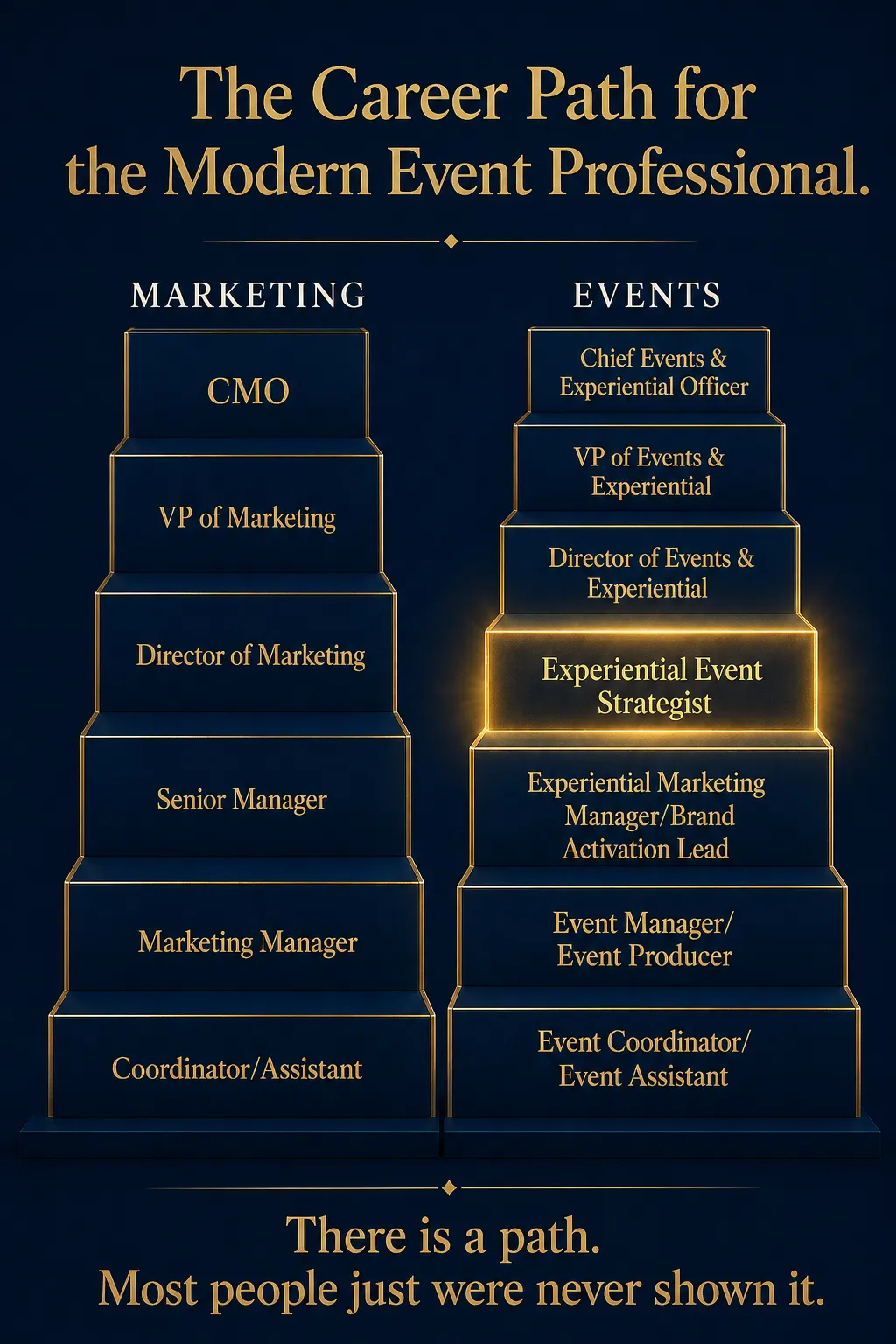
I have spent twenty years in this industry. I came from the marketing world, where the career ladder is clearly defined from day one. Coordinator to Manager to Senior Manager to Director to VP to CMO. Everyone in marketing knows where they are going and what the next step looks like. They have language for it. They have titles for it. They have a roadmap.
We never had that. And I think that absence has cost this profession more than we realize.
We Handed Events to the Wrong People and Then Wondered Why They Did Not Work
Events are routinely handed to executive assistants, HR directors, and office managers. Not because those professionals are unqualified human beings. They are often brilliant. But because organizations do not yet see events as strategic work. They see them as logistical work. And logistical work gets distributed to whoever has bandwidth.
Which means a talented HR director is now planning the company offsite on top of her actual job. An executive assistant is managing a client dinner for two hundred people while also managing a C-suite calendar. An office manager is sourcing venues while also ordering office supplies.
No company would walk up to their accountant and say: hey, can you cover sales this quarter? I know it is not your job but we need more revenue.
That would be absurd.
But we do this with events every single day. And then we wonder why events do not get the budget, the respect, or the results they deserve.
The work is being done by people who were never set up to do it strategically. That is not a criticism of those people. That is an indictment of how we have defined the profession.
The Career Path Was Always There. We Just Never Named It.
Here is what I know to be true. There are event professionals sitting at $200K, $300K, even $500K. They got there through sheer talent, tenacity, and figuring it out without a map. That is genuinely extraordinary and I have enormous respect for it.
But for every one of those professionals, there are thousands more who hit $65,000 and stopped. Not because they ran out of talent. Not because they stopped working hard. But because nobody ever showed them where the next step was.
The marketing world has a CMO. It has always had one. Events deserves the same clarity.
So I built it.
The Career Path for the Modern Event Professional maps the full trajectory of this industry the way it has always existed but never been named. Event Coordinator. Event Manager and Event Producer. Experiential Marketing Manager and Brand Activation Lead. Experiential Event Strategist. Director of Events and Experiential. VP of Events and Experiential. Chief Events and Experiential Officer.
That glowing step in the middle is where everything changes. That is the pivot point. That is where you stop executing other people's visions and start architecting your own. That is where you go from planner to strategist. From vendor manager to business driver. From invisible to indispensable.
The Only Way This Changes
Event professionals have to start speaking the language of business outcomes.
We have to walk into rooms with strategy documents instead of vendor lists. We have to produce impact reports instead of photo albums. We have to stop leading with what the event looked like and start leading with what the event did.
When events are seen as the business drivers they actually are, when we can demonstrate that an experience generated qualified leads, accelerated pipeline, retained at-risk clients, or shifted brand perception, everything changes.
We earn the budget. We earn the respect. We earn the dedicated seat at the table that this profession has always deserved and never quite claimed.
The path from planner to director is not paved with more events.
It is paved with strategy. With language. With the ability to connect what happens in a room to what happens in a boardroom.
That is the work. And it is absolutely learnable.