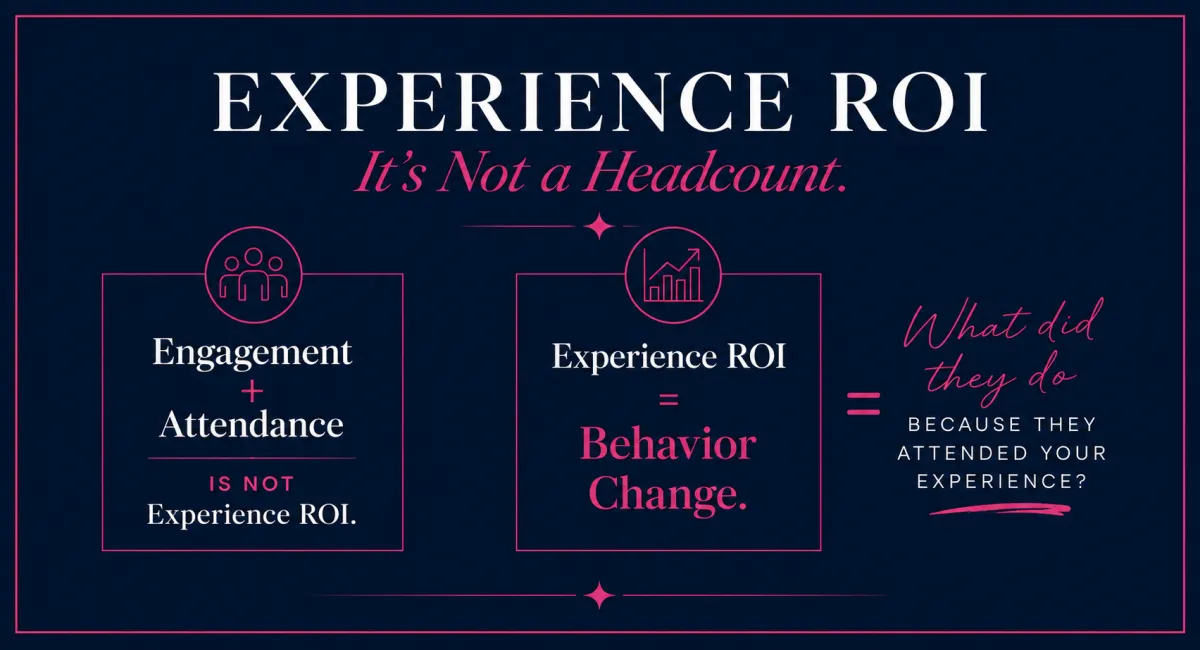
Experience ROI Is Not a Headcount
I used to think I designed successful events.
Three years in a row I produced the same event. Attendance grew every single year. Three hundred attendees became five hundred and fifty became seven hundred. The room was full. The energy was high. The decor was off the charts. The sponsors had their logos everywhere. By every visible measure, it was working.
And then the sponsors stopped coming back.
Not all at once. Gradually, and then it felt like pulling teeth to get someone to sign up to sponsor the event. And when I sat down to make the case for why they should return, I had nothing. I had a headcount. I had some social media posts with decent engagement and fabulous design. I had a room full of people who showed up, drank, ate and had a great time and then went home and did absolutely nothing different because of the experience I created for them.
I could not tell you what a single attendee purchased after leaving. I could not tell you whether anyone moved further down a sales pipeline, changed a vendor relationship, or made a single decision because of what happened in that room. I had produced a very expensive, very well attended, very completely unmeasurable experience three years in a row and called it a success.
It was not a success. I just did not have the framework to know that yet.
Here is what I know now. Attendance is a headcount. It tells you how many people showed up. It tells you nothing about what showing up did to them. Engagement without definition and measurement is a social media post. It feels good. It does not prove anything. Neither of those metrics answers the only question that actually matters to the people writing the checks.
What did they do because they attended your experience?
That is Experience ROI. Not how many came. Not how many liked the post. What behavior changed because they were in that room.
When I reframe that three year event through the lens I teach now, everything looks different. I would have tracked post-experience behavior with intention. I would have defined what success looked like for each sponsor before the event, not after, and I would have educated them on how to activate their own brand inside the experience to generate the outcomes they were paying for. I would have measured across five specific pillars instead of counting seats and crossing my fingers.
The sponsors were not wrong to leave. They were not getting value. They were not getting value because I had not built a system that could deliver it, track it, or prove it.
That is the conversation the experiential industry needs to stop avoiding. We are spending $128 billion annually on live experiences and only 23% of marketers can prove they worked. The gap is not effort. It is not creativity. It is not even budget. It is the absence of a measurement framework built specifically for what experiences are designed to do.
Experiences are designed to change behavior. They work through emotion. Emotion is the mechanism that triggers action, and action is what produces measurable business outcomes. That is not theory. That is the framework I now teach inside the CPES certification and it is exactly what I wish I had when I was standing in a room of seven hundred people wondering why my sponsors were not calling me back.
You do not need a bigger event. You need to know what your event is supposed to make people do, and you need to be able to prove that it did.
That is the difference between a headcount and a result.