The Behavioral Outcome Chain: Why Every Event Should Start at the End
The Behavioral Outcome Chain: Why Every Event Should Start at the End
Most event professionals start with the experience. The ones who get results start with the outcome.
I want to tell you something that took me years of producing lavish, expensive, wildly impressive events to figure out.
Most of us build events the wrong way around.
We start with the venue. Or the theme. Or the budget. We build an experience and then, somewhere near the end, someone asks the question we should have asked at the very beginning: did it work?
The problem is not the event. The problem is the order of operations.
When I went deep into behavioral science, neuroscience, and the psychology of memory, I kept arriving at the same conclusion. Outcomes do not happen by accident. They happen by design. And design only works when you know what you are designing toward.
That is how I built the Behavioral Outcome Chain. It is the foundation of everything I teach inside CPES, and it is the framework that changed the way I produce every single event.
What is the Behavioral Outcome Chain?
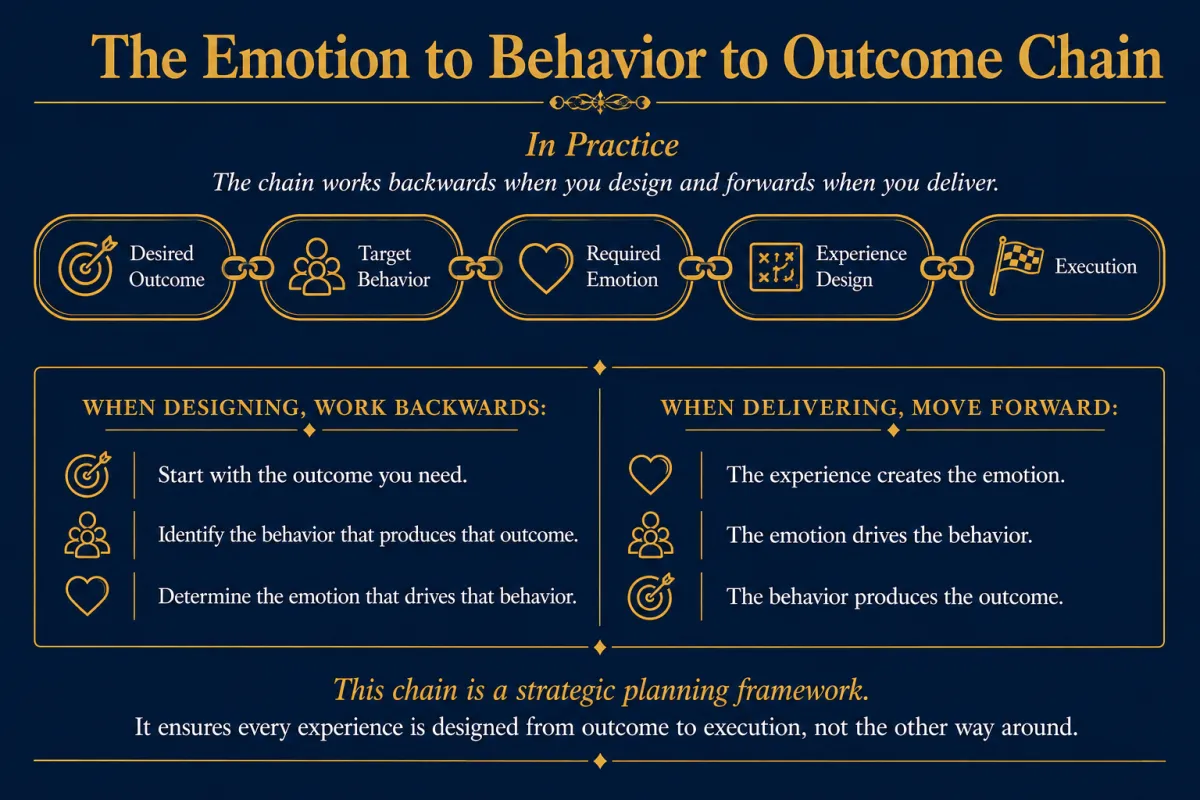
The chain is simple. Five links. Two directions. One rule: you design it backwards and deliver it forwards.
Desired Outcome → Target Behavior → Required Emotion → Experience Design → Execution
When you are designing an event, you work backwards from the outcome you need. When you are delivering it, you move forward through the chain. The experience creates the emotion. The emotion drives the behavior. The behavior produces the outcome.
Not maybe. Not hopefully. By design.
Here is what that looks like in practice
When designing, work backwards: Start with the outcome you need. Identify the behavior that produces that outcome. Determine the emotion that drives that behavior.
When delivering, move forward: The experience creates the emotion. The emotion drives the behavior. The behavior produces the outcome.
This is not a creative framework. It is a strategic one. It means that every decision you make — the room, the lighting, the speakers, the timing, the moment of silence — is in service of an emotion that is in service of a behavior that is in service of a result.
Nothing is decorative. Everything is intentional.
Why this changes everything
When you build events this way, something shifts. You stop guessing whether it worked. You stop defending your budget with attendance numbers and post-event surveys that nobody reads. You start walking into every debrief with data that proves the event did exactly what it was supposed to do.
That is what strategy looks like. And it starts with a single question: what outcome do I need from this event?
Everything else follows from there.
The Behavioral Outcome Chain is the strategic framework behind the Experiential Edge Blueprint, the five pillar methodology I teach inside CPES.